

“Found them through internet search. Requested mobile installation. They called back within 2 hours to set up an appointment. Turns out they had a shop near me, which saved me 50% on installation cost. Took about an hour.
Prompt, quick, professional service. So much cheaper than getting another car. I would highly recommend their service to anyone who needs a hybrid battery replacement.”

Chris Walker
January 2, 2025
”I was so grateful that my friend told me about this company. What I thought was going to be a $8,500.00 repair, as quoted to me by my regular auto shop, turned into a $2,400.00 repair. I will be forever grateful to Greentec EV & Hybrid Batteries. Thank you guys so much. Their customer service was excellent over the phone, and my experience with the technician that came to my home to do the repair was also excellent. I can’t thank you all enough. You really saved me!!”
Lisa Tufano
January 10, 2025
”The hybrid battery on my prius started dying and I managed to drove to the shop so I left it with them and told me they’ll finish it by tomorrow at 11am but they done it a lot earlier and faster than I expected. The car was running great again with the purchased of 12 month warranty remanufactured. I’m highly satisfied with the work they’ve done and I recommended them big time.”
Ellrick Garcia
February 13, 2025



Why pay more at the dealership? At Greentec Auto, we offer affordable, accessible and reliable hybrid battery replacements at up to 50% less than dealership prices without compromising on quality. Get the best value with expert service, mobile installation, and a warranty you can trust.

The cost of shipping to you is included with your purchase. This offer is good for the entire continental United States. Add $200 for shipping to a residential address. Let Greentec Auto make it simple to return your core to us, ask about our reduced return shipping rates.

A refundable “core deposit” of $500.00 will be added to your order at checkout. Once we receive your old battery, we will refund the core deposit back to you minus the cost of return shipping. Cores must be returned within 45 days of purchase. This applies to shipping orders only. In all other circumstances, the core will be picked up at the time of service, no deposit required.

Once your new hybrid battery has arrived, put the core battery back into the same packaging your battery arrived in. As soon as we receive your core battery, we will refund the core deposit back to you. It’s that easy.
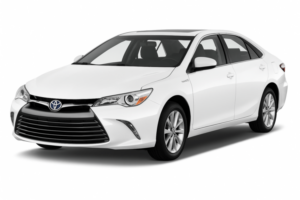
Greentec Auto builds Camry hybrid packs for the 2007 to 2011 and 2012 to 2017 cars, priced between $2,249 and $3,099 CAD depending on model years and whether you want remanufactured or brand new cells.
If your Camry is a 2018 or newer, stop here and read the next section before you price anything. There is a reasonable chance you should not be paying for this at all.
Toyota Canada’s hybrid battery coverage is unusually generous, and the figures are not the ones you will find on American sites, because Canada is measured in kilometers and the terms are different.
| Model year | Hybrid battery coverage |
|---|---|
| 2020 and newer | 10 years or 240,000 km, whichever comes first |
| 2019 and earlier | 8 years or 160,000 km |
Separately, the hybrid system components, meaning the battery control module, the hybrid control module and the inverter, stay at 8 years or 160,000 km across every model year.
The part that catches people out: this coverage transfers. Toyota Canada applies it to the original owner and to every owner after them. Buying your Camry Hybrid used did not cost you the warranty. The clock simply runs from the car’s date of first use, not from the day you bought it.
So before you spend anything:
A 2018 or newer Camry Hybrid is well inside the eight year window as of now, which is why there is no pack listed here for those cars. We are not going to stock a part most of the people asking for it should be getting free.
| Camry years | Battery | Warranty | Price (CAD) |
|---|---|---|---|
| 2007 to 2011 | Remanufactured | 24 months | $2,249 |
| 2007 to 2011 | Brand new cells | 48 months | $3,099 |
| 2012 to 2017 | Remanufactured | 18 months | $2,250 |
| 2012 to 2017 | Brand new cells | 36 months | $3,099 |
Prices shown may not be current. Check the figure on the product listing before ordering, or send us your VIN and we will confirm it.
Warranty terms apply to most qualifying batteries.
| Price range | $2,249 to $3,099 CAD |
| Longest coverage | 48 months on most qualifying batteries |
| Fits | 2007 to 2011 and 2012 to 2017 Camry Hybrid |
| Chemistry | Nickel metal hydride |
| Pack sits | In the boot, against the back of the rear seat |
| Testing | Free |
| Service | Mobile in our service areas, or shipping on most orders across Canada |
Notice that the older car gets the longer warranty on both options. That is not a pricing error. The 2007 to 2011 pack is a design we have been building for well over a decade, and the warranty reflects how confident we are in it.
Most of this page could be written by anyone selling a Camry pack. This part could not, and it is the reason our warranties run as long as they do.
A single Camry hybrid battery takes roughly 90 days to go from a donor pack to something we will put in your car. Not 90 days of waiting. 90 days of process.
Cells come out of the donor pack one at a time. Every one gets a first pass test, and anything that fails is pulled straight out and sent to Greentec Recycling rather than being nursed along. What survives goes to internal resistance testing, which is the measurement that tells you how a cell will behave under load three winters from now rather than how it reads on a bench today. Then cycle testing, charging and discharging repeatedly to see what holds.
Then the cells rest. This is the step nobody skips if they are serious and nobody bothers with if they are not. A cell that reads beautifully straight after a charge and quietly drifts over the following days is a cell that will fail in your Camry in eighteen months. Resting is how you catch it, and there is no way to hurry it.
Finally the surviving cells are matched by performance into a pack, so the finished battery works as one unit instead of a group of individuals pulling in different directions.
Most of those 90 days are testing and resting. Anyone turning a Camry pack around in a week has skipped steps, and the steps they skipped are the ones that decide whether you are back in two years.
Two generations, two different packs, and they are not interchangeable.
2007 to 2011, the XV40 Camry Hybrid. Nickel metal hydride pack, 2.4 litre engine. The first Camry Hybrid sold in Canada.
2012 to 2017, the XV50 Camry Hybrid. Nickel metal hydride again, 2.5 litre engine, and the generation most commonly on Canadian roads today.
Check the model year on the sticker inside your driver’s door. If you land on a boundary year, or you are not sure, send us the VIN and we will confirm the correct part before anything ships.
The Camry hybrid battery sits in the boot, pressed up against the back of the rear seat. You reach it from the boot side by removing the trim panel.
What matters more than where it is, is how it breathes.
The pack is cooled by a fan that draws cabin air through an intake in the rear seat area, on the right hand side. That intake is the single most consequential maintenance item on this car and almost no Camry owner knows it exists.
Block it and the pack runs hot. Heat is what destroys nickel metal hydride cells. A battery with twelve good years in it will finish at eight for no other reason.
What blocks it, in order of how often we see it:
Pet hair. By a wide margin the worst. If a dog rides in the back of your Camry, this vent needs checking twice a year without exception. We have opened intakes on dog owners’ cars and pulled out handfuls of it.
Cargo. Boxes, hockey bags, groceries, anything pressed against the rear seat on the right hand side will choke the intake completely. Canadian cars carry more gear more of the year than most, and this is where it shows up.
Dust and carpet lint, especially on cars that see gravel roads or job sites.
Child seats and back seat clutter sitting directly over the intake.
Fixing it costs nothing. Find the vent, make sure nothing is against it, put a vacuum on the grille. Twice a year is enough for most cars and four times a year if there is a dog. We check the cooling path during every diagnostic and clean it during every installation, because a new pack behind a blocked vent fails on exactly the schedule the old one did.
The Camry does not usually fail without notice. It declines, and it declines in a fairly consistent order.
Fuel consumption climbs first. A Camry Hybrid that had settled into a comfortable number starts reading noticeably worse on exactly the same commute. Most owners put this down to the season or the fuel for several months before the real cause occurs to them.
The charge display stops behaving. Rather than working through the middle of its range, it runs to full and then drops to near empty.
The engine stops shutting off. At lights, in car parks, crawling in traffic, places it used to go quiet.
Acceleration goes flat. The electric motor is no longer contributing, so the engine is moving the car on its own and you feel it immediately.
The cooling fan gets loud, or simply never stops. This often arrives before anything appears on the dash.
Then the warnings. The red triangle, Check Hybrid System, sometimes intermittently at first and frequently after the car has sat out overnight in the cold.
And eventually a stored code. The one that settles the argument is P0A80, Replace Hybrid Battery Pack. You may also see P0AA6 for an isolation fault, P3000 for the battery control system, or anything between P3011 and P3024 when a specific block has drifted out of range.
A P0A80 on a Camry is not a hint. Toyota’s own wording for that code is literally an instruction to replace the pack.

Before you commit to a four figure part, rule out the three figure ones. We find them regularly.
A blocked intake or a cooling fan that has stopped turning. The pack overheats, sets codes, and presents as failed while the cells are in reasonable condition. This is the most common false alarm we see on Camrys.
A temperature or voltage sensor that has gone bad, reporting a fault on a pack that is fine.
An inverter or converter problem.
A single code from one bad night, often a car left outside through a cold snap, which clears and does not come back.
The small auxiliary battery, which should be tested before anyone starts a conversation about high voltage work on a car that will not start.
Our testing is free and reads the pack at block level. If the answer is a vent and a fan, that is what we will tell you, and it is a far better outcome for you than a new battery.
Eight to twelve years is the usual range, or roughly 160,000 to 240,000 km. You will notice those numbers sit almost exactly where Toyota Canada set the warranty, which is not a coincidence.
Where a particular Camry lands has less to do with distance driven than most owners expect. Four things decide it:
Heat, not cold. Canadians get this backwards almost universally. Cold temporarily reduces what a nickel metal hydride pack can deliver and then gives it all back when spring arrives. Heat causes permanent capacity loss and gives nothing back. A Camry that spends its summers in the Okanagan or southwestern Ontario is ageing faster than one in Halifax, regardless of what the odometer says.
A restricted cooling vent. Covered above, entirely preventable, and the thing we see most often.
Long periods parked. Modules self discharge at slightly different rates, so a car that sits drifts out of balance. Let it go far enough and cells are damaged rather than simply tired. If the Camry is a second vehicle or a seasonal car, drive it weekly. A short run is enough.
Nothing but short trips. A Camry that never reaches operating temperature works its pack harder than one doing a mix of driving.
Distance alone tells you very little. We see 300,000 km highway Camrys with healthy packs and 140,000 km city cars from hot regions that are finished.
Someone will offer to find the weakest module, swap it, close the pack, and charge you a few hundred dollars.
Think about what every module in your Camry has been through together. The same summers, the same charge cycles, the same decade and a half. The one that gave out was not unlucky, it was simply first past the post. Drop a fresh module into that company and the fresh one gets dragged back down to meet them. The balance you bought lasts weeks, sometimes a couple of months.
Owners arrive at our door having repeated that cycle several times before accepting it is not working. Each round is another diagnosis, another teardown, another invoice and more days without the car. Added together it costs more than doing the job once, and at the end they still own a pack from 2011.
There is also the conversation at resale. Telling a buyer that one module is new and the other fifteen years’ worth are original does not help you.
We do the opposite, which is the 90 day process described above: every cell tested individually, rested, re measured, and matched so the finished pack behaves as one thing. Cells that do not make the standard are not quietly reused, they go to Greentec Recycling.
| Remanufactured | Brand new cells | |
|---|---|---|
| What it is | Tested, matched, balanced cells recovered from existing packs | Cells that have never been in a car |
| 2007 to 2011 | 24 months, $2,249 | 48 months, $3,099 |
| 2012 to 2017 | 18 months, $2,250 | 36 months, $3,099 |
| Suits | A few more years of driving, or a tighter budget | Keeping the Camry long term, or living somewhere hot |
New cells are the better battery and we are not going to pretend otherwise. They last longer, they carry double the warranty term or better, and they start without a decade of someone else’s summers behind them.
The gap is around $850. On the 2007 to 2011 car that buys you twenty four extra months of coverage, and on the 2012 to 2017 car eighteen extra months. If you are planning to keep this Camry, or if it spends its summers somewhere genuinely hot, that is where we would spend the money.
Remanufactured is a legitimate option built through exactly the same process, and for a Camry you intend to drive two or three more years it is often the sensible call.
Mobile installation is available in our service areas, which means a technician comes to your home or your workplace rather than the Camry going anywhere on a flatbed. Coverage depends on your address, so check when you book.
Shipping is available on most orders to addresses across Canada if you would rather your own mechanic fit the pack.
A core deposit applies to shipped orders only. $500, fully refundable, returned once your old pack reaches us within 45 days. When we install the battery ourselves there is no deposit, because the old one leaves with us in the same visit.
The job itself takes about an hour on most Camrys. The boot trim comes out, the packs are swapped, the system is verified, the codes are cleared, and the cooling path is cleaned while everything is open.
Greentec Auto has been replacing hybrid and EV batteries since 2012, at more than 30 locations across the U.S., Canada, and the U.K.
For most Camry owners this is a straightforward decision, and the reason is what happens if you do not.
A Camry Hybrid with a known battery fault does not get discounted by the cost of the battery. It gets discounted by what a buyer imagines the battery might cost, which is invariably a dealership figure they have never checked, plus a margin for the risk of being wrong. That gap is reliably larger than the repair.
Fix the pack and you have a Camry again. The rest of a well kept XV40 or XV50, the engine, the transmission, the bodywork, will usually go a very long way yet. These are not cars that run out of life at fifteen years for any reason other than the battery.
The comparison worth making is not what your Camry would fetch today with a warning light on the dash. It is what a comparable used sedan costs in Canada right now, and the fact that you know exactly how this one has been looked after.
Where it stops making sense is narrow, and we will say so during testing rather than sell you a pack: real accident damage, a transmission or engine fault sitting on top of the battery, or rust that has gone structural.
It goes to Greentec Recycling. These are nickel metal hydride packs, so they are processed to recover their nickel and metals content, and that material goes back into the supply chain rather than being dug out of the ground again. None of it reaches a landfill.
If you notice warning lights on your dashboard, don’t rush to the dealership for an expensive diagnostic report. Many local auto parts stores can scan your vehicle and provide error codes for free just ask them to run a quick scan with a diagnostic tool.
Above, we’ve listed some of the most common hybrid error codes. Keep in mind that the check engine light must be onfor major issues to be detected. If your vehicle is experiencing hybrid battery failure, dealerships often charge thousands of dollars for a replacement typically with a limited warranty.
At Greentec Auto, we offer a cost-effective alternative, providing high-quality hybrid battery replacements at a fraction of the price. Plus, we back our batteries with a comprehensive warranty to give you peace of mind.
Possibly. Toyota Canada covers the hybrid battery for 10 years or 240,000 km on 2020 and newer vehicles, and 8 years or 160,000 km on 2019 and earlier. Crucially, that coverage transfers to every subsequent owner, so buying used did not cost you it. Check your VIN with a dealer before spending anything.
In the boot, against the back of the rear seat, reached by removing the boot trim panel.
No. Cold temporarily limits what the pack can deliver and raises your fuel consumption until things warm up. It does not cause permanent damage. Summer heat does, which surprises most Canadian owners.
It is the most common first symptom, but wait for warm weather before concluding anything. If the number comes back down in spring it was the cold. If it is still elevated in July, book a test.
Yes. Modules drift out of balance while the car sits, and deep enough discharge damages them rather than just weakening them. Drive it weekly if it is a second car.
*Offer cannot be combined with other promotions.