“Found them through internet search. Requested mobile installation. They called back within 2 hours to set up an appointment. Turns out they had a shop near me, which saved me 50% on installation cost. Took about an hour.
Prompt, quick, professional service. So much cheaper than getting another car. I would highly recommend their service to anyone who needs a hybrid battery replacement.”

Chris Walker
January 2, 2025
”I was so grateful that my friend told me about this company. What I thought was going to be a $8,500.00 repair, as quoted to me by my regular auto shop, turned into a $2,400.00 repair. I will be forever grateful to Greentec EV & Hybrid Batteries. Thank you guys so much. Their customer service was excellent over the phone, and my experience with the technician that came to my home to do the repair was also excellent. I can’t thank you all enough. You really saved me!!”
Lisa Tufano
January 10, 2025
”The hybrid battery on my prius started dying and I managed to drove to the shop so I left it with them and told me they’ll finish it by tomorrow at 11am but they done it a lot earlier and faster than I expected. The car was running great again with the purchased of 12 month warranty remanufactured. I’m highly satisfied with the work they’ve done and I recommended them big time.”
Ellrick Garcia
February 13, 2025



Why pay more at the dealership? At Greentec Auto, we offer affordable, accessible and reliable hybrid battery replacements at up to 50% less than dealership prices without compromising on quality. Get the best value with expert service, mobile installation, and a warranty you can trust.

The cost of shipping to you is included with your purchase. This offer is good for the entire continental United States. Add $200 for shipping to a residential address. Let Greentec Auto make it simple to return your core to us, ask about our reduced return shipping rates.

A refundable “core deposit” of $500.00 will be added to your order at checkout. Once we receive your old battery, we will refund the core deposit back to you minus the cost of return shipping. Cores must be returned within 45 days of purchase. This applies to shipping orders only. In all other circumstances, the core will be picked up at the time of service, no deposit required.

Once your new hybrid battery has arrived, put the core battery back into the same packaging your battery arrived in. As soon as we receive your core battery, we will refund the core deposit back to you. It’s that easy.
Prices on this page are accurate as of the date posted and are subject to change. Check the current price on the product listing at greentecauto.ca before ordering.
Start here, because it is the single most important thing about this battery and almost nobody tells Volt owners about it.
The Chevrolet Volt battery is liquid cooled and liquid heated. It is not air cooled the way most hybrid packs are, and it is not passively cooled the way the Nissan Leaf pack is. GM gave the Volt battery its own dedicated cooling circuit, built much like an engine cooling system, with its own coolant, its own pump and its own reservoir.
Inside the pack, cells sit in pairs in plastic frames with aluminium cooling fins between each pair, so temperature stays even across the whole battery rather than pooling in the middle.
It is a large part of why Chevrolet Volt batteries have aged as well as they have. A pack that can actively shed heat in summer and add heat in winter spends more of its life in the window where lithium cells are happy. Volt owners routinely report less degradation than owners of air-cooled EVs of the same age, and this is why.
That cooling circuit has coolant in it, and coolant does not last forever. The Chevrolet Volt battery coolant is a separate system from the engine coolant. It has its own reservoir, its own level and its own service interval, and because it sits under a car that has otherwise been very reliable, it gets forgotten.
A Volt battery cooling system that is low on coolant, or running old coolant, or has a failed pump, stops protecting the pack it was built to protect. The battery then ages the way an air-cooled pack ages, which is faster.
If your Volt is over ten years old and nobody has ever touched the battery coolant, that is worth looking at before you look at anything else. It is a small job next to a four figure battery, and on this particular car it is the maintenance that actually moves the needle.
GM took this seriously enough that a 2012 safety update added a coolant level sensor and a tamper-resistant reservoir bracket to earlier cars, which tells you how central the cooling circuit is to how this battery works.
| Volt years | Battery | Warranty | Price CAD | Previously |
|---|---|---|---|---|
| 2011 to 2012 | Remanufactured | 18 months | $6,299 | $10,499 |
| 2013 to 2015 | Remanufactured | 18 months | $6,299 | $10,499 |
| 2011 to 2012 | Replacement pack | 36 months | $11,199 | $17,499 |
| 2013 to 2015 | Replacement pack | 36 months | $11,199 | $17,249 |
| 2016 to 2019 | Replacement pack | 36 months | $13,999 | $17,499 |
Prices on this page are accurate as of the date posted and are subject to change. Check the current price on the product listing at greentecauto.ca before ordering.
The spread is $6,299 to $13,999. Two things decide where you land: which generation you own, and whether you take a remanufactured pack or a full replacement.
Remanufactured and new are not the same product. A remanufactured Chevrolet Volt battery is built from recovered modules that have been individually tested, graded and matched into a working pack. It is a genuine engineered product with a warranty behind it. A replacement pack carries double the warranty term and no accumulated cycle history. We are not going to describe the two as equivalent, because they are not.
There is no remanufactured option listed for the 2016 to 2019 car. Second generation Volt owners have one listing, at $13,999 with 36 months.
Compare against a GM dealer quote, not a percentage. A Chevrolet dealer quoting a Volt propulsion battery on a car GM stopped building in 2019 is working from a parts catalogue. If you have a written quote for your own Volt, that is the number worth putting next to these.
Two generations, and the batteries are substantially different.
| First generation, 2011 to 2015 | Second generation, 2016 to 2019 | |
|---|---|---|
| Total battery capacity | 16.0 kWh, rising to 16.5 then 17.1 kWh | 18.4 kWh |
| Usable capacity | Roughly 10.3 to 10.9 kWh | 14 kWh |
| Cells | 288, in nine modules | 192 |
| Cell chemistry | Lithium manganese oxide, LG Chem | LG Chem, revised chemistry |
| Battery pack weight | About 197 kg | About 13 kg lighter than the first generation |
| Electric range, rated | 56 km early cars, 61 km from 2013 | 85 km |
| Thermal management | Dedicated liquid circuit | Dedicated liquid circuit |
This catches people out. A first generation Volt battery is not one thing:
Notice how much of the battery the Volt never let you use. A 2011 Volt had 16.0 kWh in the pack and used about 10.3 of it. GM deliberately kept the battery away from both extremes of charge, which is the other major reason these packs have lasted. Owners comparing current range against the total kWh figure are measuring against capacity the car was never willing to spend.
Order against your exact model year. Send us the VIN or the year and we will confirm which Volt battery listing applies.
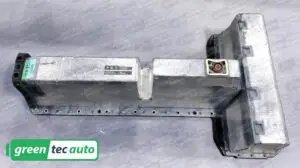
In the centre tunnel. The Chevrolet Volt battery is T-shaped, running down the raised tunnel between the front seats and then widening out under the rear seat. It is why a Volt has four seats rather than five, and it is why the pack is so well protected in a collision.
It also means anyone working inside the car, on the centre console, the seats or the floor, is working near a high voltage battery. Tell any shop that has your Volt in for interior or structural work that the pack runs down the middle of the car.
The Volt handles cold better than most plug-in vehicles of its era, and the reason is the heated battery circuit described above. That does not mean nothing changes below freezing.
Electric range falls in cold weather. Every plug-in loses range in winter. A Volt rated at 61 km will not deliver 61 km at minus 20, and that is physics rather than a fault. What makes the Volt different is that it has a petrol engine to fall back on, so a cold morning costs you fuel rather than stranding you.
The engine may start when you did not ask it to. In cold conditions the Volt runs the engine to produce heat, for the cabin and in some circumstances for the battery. On the second generation car there is a setting controlling how aggressively it does this. An engine starting on a cold morning in a car with charge left in the battery is usually the heating system, not a battery fault.
“Battery too cold, plug in to warm.” A genuine Volt message. The car is telling you the pack is below the temperature at which it will take or deliver full power, and that plugging in lets it warm itself on grid power rather than on its own charge. This is the thermal management system doing exactly what it was built to do.
Plugging in overnight in winter is the single best habit a Canadian Volt owner can have. It lets the car condition the battery using wall power instead of pack energy, so you start the day with a warm battery and full range rather than spending part of your charge heating the pack.
Electric range that keeps falling as the weather warms up, range that never recovers in spring, or an engine that now runs almost constantly in conditions where it used to stay off. Those point at the battery rather than the season.
Worth stating plainly, because the names are one letter apart and the search results mix them constantly.
The Chevrolet Bolt EV has been subject to a major battery fire recall. If you own a Bolt, check your VIN with GM or Transport Canada and deal with any open recall through a Chevrolet dealer before considering any paid battery work. That is not a sales position, it is the only sensible order to do things in.
The Volt is a different vehicle with a different battery from a different era. The Volt had its own safety action in January 2012, after post-crash testing, which added structural reinforcement around the pack and changes to the coolant system. GM kept the cell chemistry and the cooling design. NHTSA closed its investigation that same month. That action is long completed.
If you are unsure which car you have: the Volt has a petrol engine and a charging port, and it was built from 2011 to 2019. The Bolt EV is fully electric with no engine at all.

Electric range falling and not coming back. The clearest sign a Chevrolet Volt battery is losing capacity. A Volt that used to show 55 km of electric range on a full charge and now shows 30, in the same weather, on the same commute, is telling you about the battery rather than the season.
The engine running far more than it used to. The Volt is built to run on battery first and bring the engine in when the charge is used up. A Volt whose engine starts earlier and earlier in each journey is a Volt with less battery to spend.
Fuel consumption rising. Follows directly from the above. Owners who used to fill up every couple of months find themselves at the pump far more often, with no change in how they drive.
“Propulsion Power Reduced” or similar warnings. Messages about reduced power point at the battery or its control system.
“Service High Voltage Charging System.” Worth having read properly rather than guessed at.
A charge that completes much faster than it used to. If the car reaches full in noticeably less time on the same charger, the pack is accepting less energy than it did.
No single symptom is a diagnosis. On this car in particular, check the battery cooling system before concluding the battery is finished. Low coolant, a failed pump or a cooling fault can produce symptoms that look like a dying Volt battery, and the fix is a fraction of the cost.
Have the codes read before anyone quotes you a pack.
| Code | Meaning | Battery replacement usually needed |
|---|---|---|
| P0A80 | Replace hybrid or propulsion battery pack | Yes |
| P0A7F | Hybrid battery pack deterioration | Yes |
| P0AFA | Hybrid battery system voltage low | Investigate |
| P0A0D | High voltage system interlock circuit | Interlock or service disconnect, not the pack |
| P0AA6 | High voltage system isolation fault | Can be the battery or a cable |
| P1FFF, P1E00 | Propulsion system disabled or service required | Points to the system, needs full reading |
| P0C78, P0C77 | Battery coolant or thermal management faults | Cooling system, not the battery itself |
Pay attention to the coolant and thermal codes. On a car with a dedicated liquid cooled battery, a cooling fault is its own problem with its own fix. Replacing the pack without addressing it means putting a new battery into the same conditions.
Anyone quoting you a Volt battery off a single code, without reading the full set and checking the cooling circuit, has not diagnosed the car.
The Volt has a better record here than most plug-ins of its era, and the reasons are the ones already covered: a liquid cooled and heated pack, and a deliberately conservative charge window that kept the battery away from both extremes.
Plenty of first generation Volts are still returning usable electric range at well over 200,000 km. Others have lost enough capacity to be worth addressing. The variation comes down to climate, charging habits and whether the cooling system has been maintained.
A neglected battery cooling system. The biggest factor in Chevrolet Volt battery degradation, and the most preventable.
Sustained heat. Less of an issue in most of Canada than in the southern United States, but a Volt that spends summers in southern Ontario parked in full sun is working harder than one in a garage.
Sitting at full charge for long periods. Lithium cells age faster held at the top of their range. The Volt’s own management already limits this, but leaving the car plugged in and full for weeks does not help.
Long storage at low charge. The opposite problem, and also unhelpful.
Very high mileage in pure battery use. A Volt driven entirely on electricity, charged twice a day, has put far more cycles through the pack than one driven mostly on the motorway with the engine running.
Plugging in regularly, including through winter so the car can condition the battery on grid power, keeping the battery cooling system serviced, and parking out of extreme heat where you can.
An honest answer, because the numbers on this car are larger than on a conventional hybrid.
It usually makes sense when the car is otherwise sound, you like it, and the battery is genuinely what is holding it back. A Volt with a healthy engine, a solid body and a working interior is a capable car that GM no longer builds, and parts of it are hard to replace with anything comparable at the same money.
It usually does not when the car has significant rust, a failing engine or transmission, or substantial other deferred work. No battery is worth putting into a car that is finished for other reasons, and we will say so.
The in-between case is a Volt where the owner is weighing replacement against selling. Worth knowing: a Volt with a known-bad battery sells for a steep discount, because every informed buyer prices in the replacement and then adds a margin for uncertainty. The gap between what you lose on the sale and what the battery costs is often narrower than people expect.
Before you decide anything, have the battery cooling system checked. On this car more than any other we work on, that check sometimes changes the answer entirely.
Mobile installation is available in our service areas. A technician comes to your home or your workplace rather than the Volt going anywhere on a flatbed. Coverage depends on your address, so confirm it when you book. Installation is quoted separately.
In shop service is available at our Coquitlam, BC location.
Shipping to your own technician is available on most orders if you would rather have your own shop handle the work.
Chevrolet Volt battery packs are large, heavy and classified as dangerous goods for transport, so they move by freight on a pallet. Expect a delivery appointment rather than a doorstep drop, and expect the carrier to want a phone number.
Every Chevrolet Volt battery that comes back to us is assessed at module level.
These are lithium-ion packs, so the recoverable materials are lithium and cobalt and the other metals in the cells, which is a different recovery route from the nickel in an older hybrid pack.
Modules that fail assessment go to Greentec Recycling for materials recovery. Modules that still hold usable capacity can go on to second life applications in energy storage, where a module that no longer satisfies a car can do useful work for years.
Greentec Recycling is a new operation, established in 2025, so we are not going to publish volumes we have not accumulated. What we can tell you is the destination.
Greentec Auto Canada operates from 1560 Booth Avenue, Coquitlam, BC, and Greentec Auto runs more than 30 locations across Canada, the United States and the United Kingdom.
We take Chevrolet Volt enquiries from across Canada. Get in touch before making travel arrangements so we can confirm the correct battery for your vehicle, current availability and what happens next.
Useful to have ready:
If you notice warning lights on your dashboard, don’t rush to the dealership for an expensive diagnostic report. Many local auto parts stores can scan your vehicle and provide error codes for free just ask them to run a quick scan with a diagnostic tool.
Above, we’ve listed some of the most common hybrid error codes. Keep in mind that the check engine light must be onfor major issues to be detected. If your vehicle is experiencing hybrid battery failure, dealerships often charge thousands of dollars for a replacement typically with a limited warranty.
At Greentec Auto, we offer a cost-effective alternative, providing high-quality hybrid battery replacements at a fraction of the price. Plus, we back our batteries with a comprehensive warranty to give you peace of mind.
In the centre tunnel. The pack is T-shaped, running between the front seats and widening under the rear seat, which is why the first generation Volt seats four rather than five.
Yes, and that matters. The Volt battery has its own dedicated cooling circuit with its own coolant, pump and reservoir, plus aluminium cooling fins between cell pairs. It both cools the pack in heat and warms it in cold. It is a major reason Volt batteries have held up better than air cooled packs of the same age.
It is a real maintenance item and it is widely forgotten. The battery cooling circuit is separate from the engine cooling system, with its own reservoir and its own service interval. On a Volt over ten years old that has never had it touched, this is worth checking before anything else.
Usually because the car is producing heat for the cabin, and in some conditions for the battery. On second generation cars there is a setting that controls how readily it does this. An engine starting on a cold morning is normally the heating system rather than a battery problem.
There was a safety action in January 2012, following post-crash testing, which added structural reinforcement around the battery and changes to the coolant system. GM kept the cell chemistry and the cooling design, and NHTSA closed its investigation that same month. It is long completed.
*Offer cannot be combined with other promotions.